Force Arrows in the Lo Shu Grid
Discover how Force Arrows reveal your natural gifts and dominant traits through the patterns formed when three aligned cells are all present in your Lo Shu Grid.
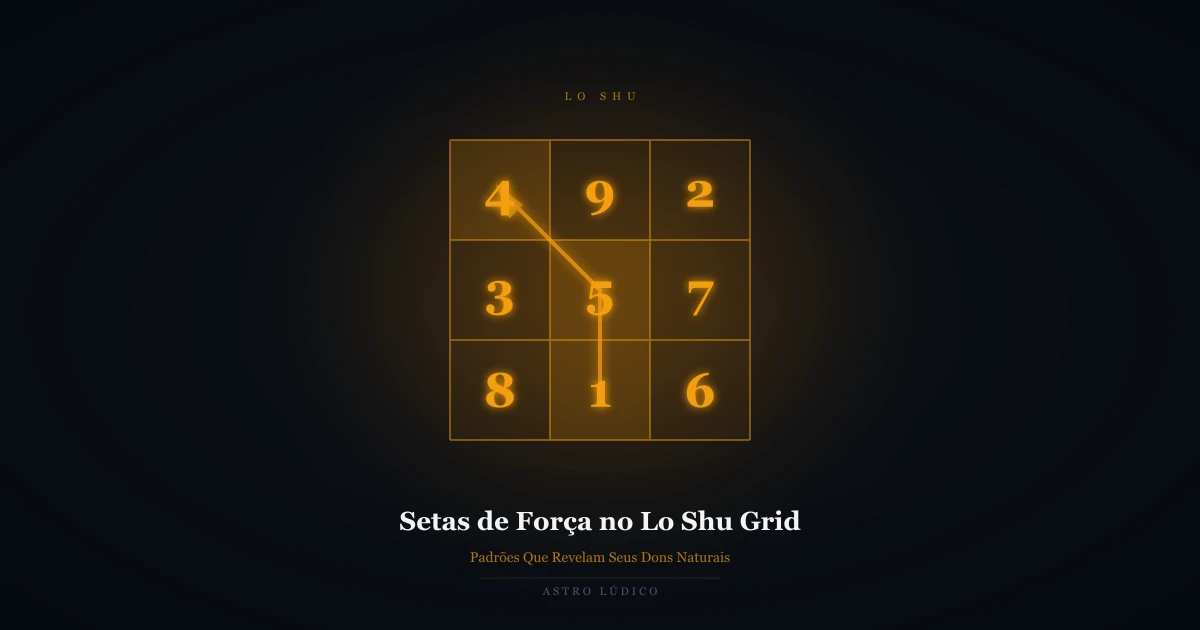
When you map the digits from your birth date onto the Lo Shu Grid, something interesting can happen: three cells in a row, column, or diagonal all fill up at once. This alignment is called a Force Arrow, and it signals a concentrated stream of energy in your numerological profile. Force Arrows do not appear in every chart, which makes them especially meaningful when they do. Each arrow points to a natural strength — a quality that flows with less resistance, a talent that tends to show up early and persist throughout life.
What Is a Force Arrow?
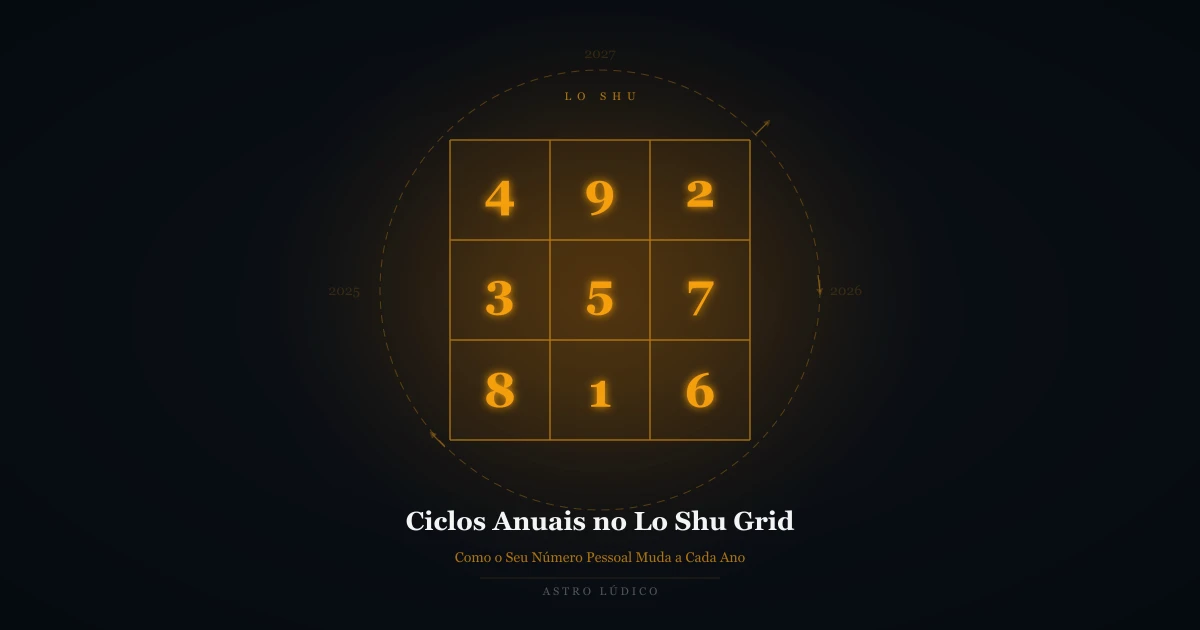
A Force Arrow forms when all three cells of a complete row, column, or diagonal in the Lo Shu Grid are occupied by at least one digit from your birth date. The grid has eight possible lines: three rows, three columns, and two diagonals. Each line carries a specific theme, and when every cell of that line is activated, the theme becomes a defining characteristic of the person's energy. Think of it as a triple confirmation — the universe echoing the same quality across three different frequencies.
- A Force Arrow requires all three cells of the same row, column, or diagonal to contain at least one digit.
- The eight possible arrows each carry a distinct meaning related to personality and natural abilities.
- Having multiple Force Arrows in the same chart indicates a particularly focused and active profile.
- Force Arrows complement individual number readings by revealing emergent group patterns.
Arrow of Determination (1–5–9)
The Arrow of Determination runs along the main diagonal of the Lo Shu Grid, connecting cells 1, 5, and 9. This is considered one of the most powerful arrows in the system because it links the personal will (1), the center of balance and adaptability (5), and the completion energy (9). People who carry this arrow tend to be goal-oriented, resilient, and difficult to discourage. They set their sights on something and pursue it with a steady, almost quiet persistence. This is not necessarily dramatic ambition — it is a deep inner certainty that keeps them moving even when external circumstances push back.
Arrow of Intellect (3–5–7)
The Arrow of Intellect crosses the middle row of the grid, connecting creativity (3), the integrating center (5), and inner wisdom (7). This arrow marks a mind that is both sharp and curious. Those who carry it often enjoy learning for its own sake, can process complex information relatively quickly, and tend to think before acting. They are natural analysts who feel most comfortable when they can understand the structure behind things. In conversation, they are often precise and thoughtful, preferring accuracy over speed.
Arrow of Compassion (2–5–8)
The Arrow of Compassion runs along the secondary diagonal, linking emotional sensitivity (2), the balancing center (5), and material strength (8). This arrow describes people with a natural ability to sense what others need, often before it is spoken aloud. They are drawn to caregiving, counseling, and any role that involves supporting others through difficulty. Their empathy is not passive — it is an active force that motivates them to show up, listen deeply, and offer concrete help. The combination of emotional attunement with the grounding energy of 8 makes their compassion both heartfelt and practical.
Arrow of Practicality (1–2–3)
The Arrow of Practicality runs along the left column of the grid, connecting numbers 1, 2, and 3. This line is associated with the ability to take ideas out of the abstract and bring them into the real world. People with this arrow are methodical, organized, and good at execution. They do not just dream — they plan, list, and build. Details matter to them, and they often have a natural talent for managing multiple tasks without losing track of the overall picture. In teams, they are the ones who turn conversations into checklists and checklists into results.
Arrow of Spirituality (7–8–9)
The Arrow of Spirituality occupies the top row of the Lo Shu Grid, connecting inner reflection (7), material manifestation (8), and universal completion (9). This arrow is linked to philosophical thinking, intuitive knowing, and a felt sense of purpose that goes beyond daily routine. Those who carry it often experience moments of insight that feel less like logical conclusions and more like recognition — as if they are remembering something rather than discovering it for the first time. They are drawn to questions of meaning, tend to see patterns others miss, and often feel a pull toward service or legacy.
Arrow of Planning (4–5–6)
The Arrow of Planning runs across the middle row of the grid — left to right — connecting patience (4), balance (5), and harmony (6). This arrow speaks to the ability to think ahead, manage expectations, and create environments where things work smoothly over time. People with this arrow tend to be good mediators, long-range thinkers, and natural strategists. They understand that sustainable outcomes require preparation and that rushing past the middle steps usually costs more time in the end. They are the ones who ask: what happens after the plan succeeds, and are we ready for that?
How Multiple Arrows Interact
When two or more Force Arrows appear in the same map, they create compound patterns that reinforce or nuance each other. For example, someone who has both the Arrow of Determination and the Arrow of Intellect carries both focused willpower and sharp analytical ability — a combination that often produces people who are effective precisely because they can sustain effort and think clearly under pressure. When arrows share a common cell, that shared number becomes an amplified focal point in the reading. The number 5, which sits at the center and appears in three of the eight possible arrows, is worth special attention whenever multiple arrows are present.
- Arrows that share the number 5 at center are especially powerful because 5 amplifies all energy flowing through it.
- Two arrows crossing at the same cell create an intensified focal theme.
- Conflicting arrow themes — such as compassion and analytical intellect — are not contradictions; they reflect a more complex, layered personality.
- The total count of active arrows gives a rough measure of energetic concentration in the chart.
- Arrows that run in perpendicular directions often describe people who balance action and reflection naturally.
The Lo Shu Grid reminds us that the numbers we carry are not just scores to be judged as good or bad. Force Arrows in particular show us where energy moves easily and where natural gifts are waiting to be developed. Recognizing your arrows is not a reason to stay only in your comfort zone — it is a starting point for understanding which qualities are already strong in you, so you can deploy them intentionally. Used with self-awareness, this knowledge becomes a practical guide for decision-making, relationship building, and personal growth.
About the Author: Kelwin Felipe
Creator of Astro Lúdico, software developer and independent researcher in Cabalistic Numerology, dedicated to translating ancestral wisdom into practical and intuitive tools for self-knowledge.
Related Articles
Notice: The content on Astro Lúdico is for informational and educational purposes only, based on symbolic systems such as numerology and the Major Arcana. It does not constitute medical, psychological, legal, or financial advice. Tool results should be interpreted as reflections on symbolic energetic patterns, not as absolute truths.